Showing posts with label Africa. Show all posts

Wednesday, June 17, 2015

Who’s Afraid of African Democracy?

We reproduce a short piece by Helen Epstein (author of "The invisible Cure" on the fight against AIDS in Africa) in the New York Review of Books  reviewing Adam Branch and Zachariah Mampilly’s Africa Uprising: Popular Protest and Political Change  and simultaneously addressing the latest episodes of social and political unrest in the African continent (notably Burundi but also Burkina and the DRC with mentions to Senegal and Uganda) within a larger framework of Western support to autocratic and seemingly perpetual regimes in the region. A backing rooted in the adjustment programs dictated by the IMF and World Bank and renewed with the so-called War on Terror. We have added hyperlinks and some context material at the end.


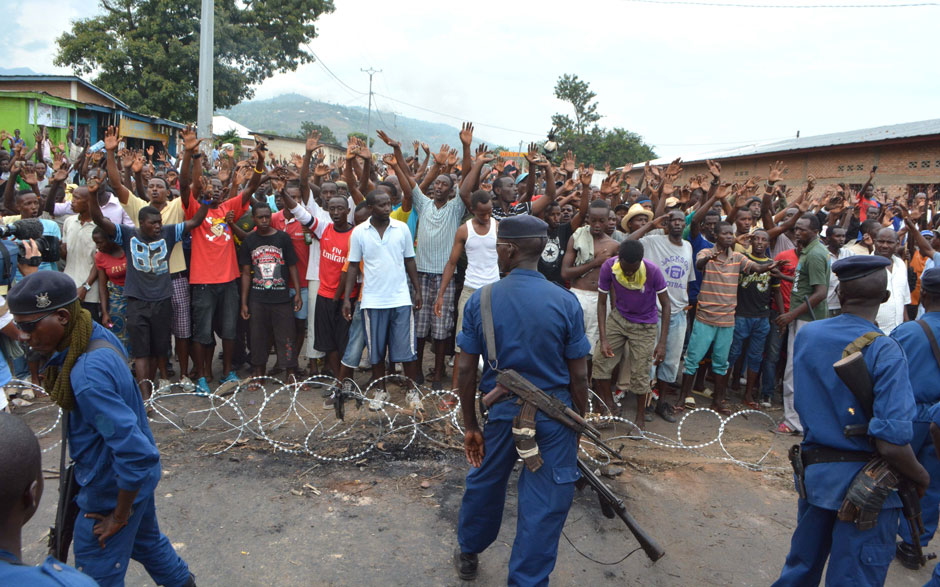
Ndabashinze Renovat/Anadolu Agency/Getty Images Security forces facing off with protesters in Bujumbura, Burundi, May 20, 2015

Who’s Afraid of African Democracy? Helen Epstein New York Review of Books  May 21, 2015

Poor Burundi. Landlocked, tiny, and known mainly for ethnic conflict, it was for years the subject of one of the most intense international peace-building efforts in history. By the time the Arusha Peace Agreement was finally signed in 2003, 300,000 Burundians had died in a civil war rivaling in ferocity that of its neighbor Rwanda. Huge sums had been invested in grassroots workshops, high-level meetings and summits to end the fighting. According to Burundi specialist Peter Uvin, taxi drivers in the capital Bujumbura joke that the per diems received during these protracted negotiations built the poshest neighborhood in the city. Now, a decade after the peace process came to what seemed a successful conclusion, and despite billions of dollars in humanitarian aid, the country appears to be falling apart again.

Wednesday, May 27, 2015

Philanthrocapitalism. Self-servicing charity on the name of the impoverished

In recent years a new trend is increasingly gaining hold in international cooperation circles: philanthrocapitalism or the use of market rules and tools to advance such goals as education, public health or water sanitation by individuals like Bill Gates, Warren Buffet and other corporate magnates.
 However, there is a growing sense of  concern regarding the potential conflict of interests and moral dilemmas posed by transnational corporations replacing non-for-profit  entities and intergovernmental organizations in alleviating misery and poverty in many cases caused  by the very same economic model where they thrive and profit.
We have selected a piece by in The Jacobin Magazine on an aspect in some ways linked to the philanthrocapitalism which is celebrity activism. Which agenda is serving this kind of activism and who ultimately benefits are some of the issues forcefully tackled by this piece. We have added hyperlinks and context material at the end. 


When there is a problem in Africa, who are you going to call? Bob Geldof and Bono repeatedly nominate themselves. But why should anyone’s fate be entrusted to the delusional, creepy, self-parodying rock-star messianism of this pair of rich tax dodgers? What do they have to offer?
The short answer is, they offer us a spectacle. And a spectacle, as Guy Debord argued, is not just a collection of images. It is a social relationship mediated by images. Those who participate in the spectacle get to experience this social relationship in a special way by consuming the images.
The spectacle of Band Aid — a “charity supergroup” responsible for the 1984 festival Live Aid and its hit single, “Do They Know It’s Christmas,” and subsequent events including the 2005 debt campaign Live 8 — is rooted in a colonial relationship to Africa in which, as the political scientist Graham Harrison has shown, “Britishness” is traditionally constructed through campaigns to “save” the continent from blights and disasters. The “feel good” factor derives from the spectacle-positioning of Britain as “doing good” in the world.

Saturday, March 2, 2013

Somalilàndia, sobirania sense reconeixement formal


Recuperem una nota publicada al diari digital Nationalia iniciativa del Centre Internacional Escarré per a les minories ètniques i les nacions (CIEMEN) sobre Somalilàndia territori independent que tot i no gaudir de cap tipus de reconeixement formal per part de l'anomenada "comunitat internacional" (d'Estats i Organitzacions Intergovernamentals) ha aconseguit establir institucions pròpies, consolidar un marc d’estabilitat en un sub-context geografic  especialment convuls, tot negociant l'explotació de recursos naturals sota la seva sobirania.
Manca de reconeixement formal que es repeteix en la multiplicitat de nacions sense Estat repartides a escala global on la negació de drets lingüístics, històrics, culturals i polítics deriven en situacions de persecució i conflicte. Simultàniament el continent africà és exemple i escenari d’Estats suposadament sobirans on la manca de legitimitat es tradueix en inestabilitat i l’ingerència de grans potències.

La inestabilitat de Somàlia durant les ultimes dues dècades ha conduit a la creació de facto de noves entitats nacionals, sense reconeixement internacional pero control efectiu sobre considerables extensions de territori, recursos i accés a sortides marítimes Font. BBC

Exploracions petrolieres i relacions internacionals: Somalilàndia és sobirana sense reconeixement formal

Nationalia 31/10/2012

La república autoproclamada manté lligams privilegiats de mutu interès amb la principal potència regional, Etiòpia · El govern somalilandès ha arribat a acords amb tres companyies per explorar el sòl a la recerca de petroli i ha anunciat l'inici imminent de l'extracció de mineral de ferro i carbó · Cap estat del món reconeix la independència de Somalilàndia, que actua com a país sobirà des de 1990
Tenir ministres que són rebuts amb honors de dignataris estatals, donar permisos a les companyies petrolieres per explorar terrenys, signar acords de defensa... Atribucions com aquestes, que habitualment són exclusives dels estats reconeguts, són assumides a la Banya d'Àfrica per Somalilàndia, una república no reconeguda oficialment per cap altre estat del món. D'entrada, la resta de països consideren que forma part de Somàlia, un país que no ha tingut control efectiu d'aquest territori des de 1990 i que pateix una guerra civil des de fa dues dècades.
Sunday, August 7, 2011

Five Myths about Africa

Departing words by Christian Science Monitor Africa's  chief correspondent Scott Baldauf after five years covering the continent. Interesting reading most specially when the Horn of Africa is  again  in the agenda of corporate media. 
Africa´s political map from Nationsonline

With the insight of five years on the ground and a summary of his travels around the continent; Mr. Baldauf proceeds to debunk five myths about Africa which shape international coverage of what happens in a 54-countries and 2,000 languages continent: "Africa is poor; Africa is violent;  Africa is technologically backward; Africa needs "our" help; and my favorite,  Africa is a country. " An interesting piece to improve our understanding of a huge continent of extreme contrasts.