Showing posts with label English. Show all posts

Monday, August 18, 2025

HRW report on US-backed Israel strategy of starving off and killing Palestinian civilians in need of humanitarian assistance.

The ongoing situation in Gaza, a Genocide for many (see here and here) and a cruel example of boundless violence on the part of Israel by most, consitutes an indictment on the ability/willigness/relevnace of the international community to uphold basic international law principles like international humanitarian law when it comes to Israela policies and actions.
Delivery of humanitarian aid to civilians trapped by the military machine of an occuppying force, has evolved from ethical dilemma to outright (man-made) catastrophe, with a number of very young children and ederly reportedly starving to death. 
This report by Human Rights Watch focuses on the features, shortcomings and punishable actions by the outfit Gaza Humanitarian Foundation; it also addresses not only the violations to IHL by Israel tantamount to war crimes but also the ultimate responsiblity of US-based private military companies  Safe Reach Solutions (SRS) and UG Solution.
The day will come when those responsible of Israel's military campaign in Gaza will be held responsible and held accountable  to the atrocities endured by Palestinian non-combattants. This report will be instrumental to establish the whom, the what and the when orders were issued and followed.

We have added context links as well as tweets by OnadaExpansiva at the end.

Gaza: Israeli Killings of Palestinians Seeking Food Are War Crimes

Abandon US-Backed ‘Death Trap’ Scheme, Press Israel to End Mass Starvation


Palestinians at a US-backed Gaza Humanitarian Foundation distribution site for humanitarian aid in the “Netzarim Corridor, "central Gaza Strip, May 29, 2025.  © 2025 Ahmad Salem/Bloomberg via Getty Images

US-backed Israeli forces and private contractors have put in place a flawed, militarized aid distribution system that has turned aid distributions into regular bloodbaths.
The dire humanitarian situation is a direct result of Israel’s use of starvation of civilians as a weapon of war—a war crime—as well as Israel’s continued intentional deprivation of aid and basic services, which amounts to the crime against humanity of extermination, and acts of genocide.
States should press Israeli authorities to immediately stop using lethal force as crowd control against Palestinian civilians, lift Israel’s unlawful sweeping restrictions on the entry of aid, and for the United States and Israel to suspend this flawed distribution system.


Saturday, August 9, 2025

Breaking the cycle of profits and patents in a pandemic

Glad to share another short piece on the TRIPS waiver discussion, originally published in the Blog of the Rosa-Luxemburg-Stiftung’s (RLS) Geneva office  in April 2022 . Unfortunately this piece has not aged well, as the outcome of the mobilization spear-headed by India and South Africa and shouldered and pushed forward by a wide coalition of civil society groups did not achieve (by far) the desired goals.


Breaking the cycle of profits and patents in a pandemic

The COVID-19 pandemic, which brought in its wake so much heartache and turmoil, did not happen in a vacuum, but within already established structures of social inequity and patterns of political imbalance. The development and subsequent procurement of vaccines followed—and continues to follow—a trend whereby the wealthy were the first to access medical technologies, while the rest were forced to wait and hope for the best. A profit-driven biomedical research and development model and the important role that intellectual property (IP) plays in the business strategies of large, transnational pharmaceutical companies were also strong winds for the perfect storm.


Solidarity is never as close and necessary to survival as when a threat, like a pandemic, makes no distinction between border or wealth, and no country would escape unscathed. The response from the international community veered from the hefty words in the early days of the pandemic proclaiming vaccines to be global public goods, to the ensuing confusing multiplication of initiatives with lofty ambitions of global distribution of vaccines. Finally, we settled on the realization that, for the European Union and other pharma-friendly governments, even in such unprecedented times, it would be business as usual when it comes to IP and access to health technologies.

Sunday, April 25, 2021

A pandemic response lacking moral leadership.

 Post originally published in Health Action International (HAI) page in March 2021
 
In October 2020, eight months after COVID-19 was declared a pandemic, India and South Africa submitted a proposal for a temporary waiver on certain articles of the World Trade Organization’s (WTO) TRIPS Agreement. This so-called TRIPS waiver would cover patents, industrial designs and copyright among other Intellectual Property (IP) protection elements of COVID-19-related health technologies, including vaccines
Support for the TRIPS waiver has extended through the Global South while wealthier countries remain fiercely opposed to even discussing the merits of the proposal. Source
Rich countries must join the world in supporting the TRIPS waiver to end the pandemic People´s Health Movement.

The idea has since been welcomed and supported by many governments at WTO (57 are now co-sponsors), civil society from across the world, and other stakeholders, such as researchers and economists. Yet it has been met with a mixture of incredulity and hostility from pharma and a small group of countries, who have spared no effort to stifle any debate on the merits of the proposal.

Thursday, September 22, 2016

Reports-Informes Recursos

In this section you will find reports, in-depth analysis and investigative materials in English, French, Spanish or Catalan on a range of issues and topics, from public health to human rights or specific national situations uploaded between 2011 and 2015 (new material will be made available weekly) . Each title provides a link to the original location, a summary or/and highlights and context information (posts in the blog, tweets and other sources). 

Other reports and analysis are to be found in posts elsewhere in the blog, like HRW´s documenting  torture under the G.W.Bush administration  and the situation in Haiti  after the earthquake or  MSF materials on Vaccine pricing

Sunday, September 18, 2016

Humanitarian Intervention´s original sin

We recover a piece from Alex De Wall (Fletcher School, Tufts University) on the legality of bombing medical facilities (protected by Article 19 of the 1949 Geneva Convention) under the light of the precedent set out by US forces in Somalia during the UN-endorsed “Operation Restore Hope” between December 1992 and May 1993.  Recent instances of disregard for medical neutrality in Yemen, Syria and Afghanistan and examples of impunity for misconduct of foreign troops operating under UN banner in Central African Republic, Haiti and Republic Democratic of Congo make this article even more relevant. We have added a few more hyperlinks and provided context information at the end of the post.

A member of US military forces walks through the remains of a church in Mogadishu, Somalia. Made in December 1992 during Operation Restore Hope Rich Mason  Flickr

Is It Ever Legal to Bomb a Hospital? On October 6, 2015

Dr. Omar was conducting an exploratory laparotomy on a female patient with a bullet wound in her abdomen when the entire hospital shook with the sound of explosions. Windows were shattering and a light and plaster fell from the ceiling. A nurse ran in to say that a missile had been fired through the wall of another operating theater, that three patients had been killed, and staff and patients were rushing to take shelter in the basement. Dr. Omar stayed with his patient, stitching her up even while the building reverberated with the assault.

Thursday, August 20, 2015

Potential Human Rights impacts of Trans Pacific Partnership Agreement (TPP)


The Trans-Pacific Partnership Agreement or TPP is a US-led  multi-lateral trade agreement being negotiated since 2006 originally by  Brunei, Chile, Singapore, and New Zealand (a.ka. P4);  joined in 2008 by Australia, Canada, Japan, Malaysia, Mexico, Peru, the United States, and Vietnam for a current total of  12 countries who reportedly represent the 40% of the world´s Gross Domestic Product (GDP); like the Transatlantic Trade andInvestment Partnership (TTIP) or the Trade in Services Agreeement (TISA), the Regional ComprehensiveEconomic Partnership or RCEP (another Pacific-area agreement which does include China) TPP is being negotiated in a secretive way: no public records of discussions,  no text of the agreement has been made public and only leaked chapters (2 out of 11) have been made available. An exception seems to have been made for lobbysts for differentindustries with stakes in the agreement such as pharmaceutical companies or financial services which through privileged access to public officials (and office holders) with responsiblity over the negotiations have been able to make sure that their clients points of view and red lines are well taken into account.

This opacity is more concerning taking into account that the issues (and policy implications) on the negotiating encompass a wide range of issues with dramatic effects and potential impact on the lives of millions; furthermore, future interpretations of clauses (also present in other MTAs being currently negotiated) such as the Investor State Dispute Settlement (ISD), the Fair and Equitable Treatment (FET,linked to International Investment Agreements) may seriously hinder (and compromise) the possibilities of successive governments to draft laws and policies deemed non-compatible with the agreement, thus seriously compromising the people´s will regarding, such issues like public services, drug prices, or environmental regulations.These MTA, if completed, would insert themselves as a higher lever of the multiple Free Trade Agreements (FTA), that the US and over 15  countries have signed in the last 10 years. All of them stipulating norms and rules that go beyond what has been agreed at the World Trade Organization (WTO) embodied most notably in what is known as TRIPS+ clauses. This would  become  the new normal, specially when the WTO seems to be gridlocked in issues such as agriculture or pharmaceutical patents issues. Again, the lives of millions of people both in rich impoverished parts of the world  are going to be affected by agreements being negotiated behind closed doors with unelected people taking  unaccountable decisions on behalf of the next generations. 
We have added, in the Reports-Informes-Recursos section, a a Third World Network Report authored by Sanya Reid Smith and  distributed, among others, by Infojustice which focus on the potential human rights impact of TPP on a variety of areas and domains.

Monday, June 29, 2015

From North to South, common goods and public services under threat

For some time structural adjustments including massive cuts to state-funded activities such as education and health or the  privatization of public enterprises and services seemed something limited to the periphery, the so-called South be it Latin America, Africa or Asia . However, as ultimate evidence of the global nature of capitalism the current recession has brought to our very shores and homes the same kind of rigid policy formulas, dictated by the very same unelected financial institutions.  In this article, appeared in Red Pepper in June 2015 Thomas McDonagh looks at the parallelisms between Bolivia´s Water war and the ongoing campaign in Ireland against the privatization of water. As usual, we have added some pictures, hyperlinks and context info at the end.
dublin-says-no
Water protesters in Ireland. Photo: William Murphy, Flickr
From Ireland to Bolivia, there’s something in the water Thomas McDonagh Red Pepper


For months people across Ireland have been protesting against the introduction of charges for domestic water – which, until the first wave of bills arrived in April, had been paid for through direct taxation. Opposition to the charges peaked on 1 November, when more than 150,000 people attended 90 different protests across the country, building on months of local campaigning. Equally spectacularly, just weeks earlier almost 100,000 people took to the streets of Dublin to express their anger at a reform that was agreed as part of the 2010 bailout brokered by the Irish government with the European Union and International Monetary Fund. The campaign still has considerable momentum and may well get a new lease of life as payment becomes a pressing issue.

Tuesday, June 23, 2015

Report on Kenya´s security forces abuses in the fight against Al-Shabaab.

We have added in the Reports section a recently released report by Human Rights Watch and the Kenya Human Rights Commission entitled  Insult to Injury documenting the abuses, arbitrary detentions and excessive use of force by Kenya´s Security Forces in the aftermath of an attack by Al-Shabaab  against villages and vehicles in Lamu County. It is not the first time (2012, 2013) that Kenya´s security forces (UK and US trained) are held responsible for human rights violations in their counterinsurgency operations.

Background
During five weeks between mid-June through July 2014, armed gunmen who in most cases claimed to be part of the Somalia-based armed Islamist group Al-Shabaab, attacked a passenger bus and at least eight villages in the Kenyan coastal counties of Lamu and Tana River. The attackers killed 87 people including four security officers, and destroyed approximately 30 buildings and 50 vehicles. Kenyan security forces were slow to respond to the attacks, leaving villages unprotected and when they eventually responded, their actions were of ten discriminatory, beating, arbitrarily detaining and stealing personal property from Muslim and ethnic Somalis in the two counties. A year later, despite numerous law enforcement operations along the coast, hundreds have been arrested and mistreated, only to have charges dropped for lack of evidence and no one has been held responsible for the attacks.

Wednesday, June 17, 2015

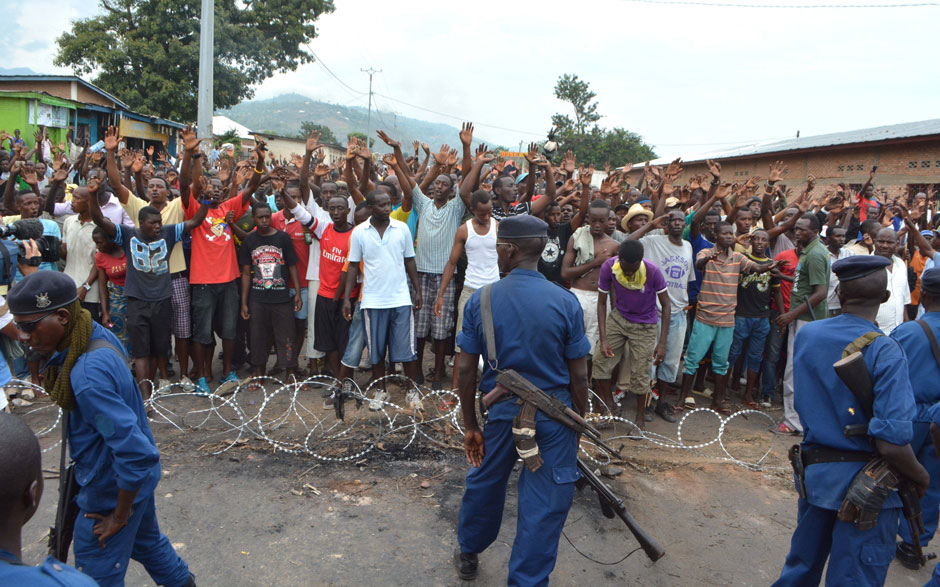
Who’s Afraid of African Democracy?

We reproduce a short piece by Helen Epstein (author of "The invisible Cure" on the fight against AIDS in Africa) in the New York Review of Books  reviewing Adam Branch and Zachariah Mampilly’s Africa Uprising: Popular Protest and Political Change  and simultaneously addressing the latest episodes of social and political unrest in the African continent (notably Burundi but also Burkina and the DRC with mentions to Senegal and Uganda) within a larger framework of Western support to autocratic and seemingly perpetual regimes in the region. A backing rooted in the adjustment programs dictated by the IMF and World Bank and renewed with the so-called War on Terror. We have added hyperlinks and some context material at the end.


Ndabashinze Renovat/Anadolu Agency/Getty Images Security forces facing off with protesters in Bujumbura, Burundi, May 20, 2015

Who’s Afraid of African Democracy? Helen Epstein New York Review of Books  May 21, 2015

Poor Burundi. Landlocked, tiny, and known mainly for ethnic conflict, it was for years the subject of one of the most intense international peace-building efforts in history. By the time the Arusha Peace Agreement was finally signed in 2003, 300,000 Burundians had died in a civil war rivaling in ferocity that of its neighbor Rwanda. Huge sums had been invested in grassroots workshops, high-level meetings and summits to end the fighting. According to Burundi specialist Peter Uvin, taxi drivers in the capital Bujumbura joke that the per diems received during these protracted negotiations built the poshest neighborhood in the city. Now, a decade after the peace process came to what seemed a successful conclusion, and despite billions of dollars in humanitarian aid, the country appears to be falling apart again.

Monday, June 1, 2015

Slavoj Žižek on Political Correctness


We have added a short talk  by Slavoj Žižek  in the videos section where the Slovenian philosopher develops the case against political correctness, which he considers risks becoming in an expression of Totalitarianism. Along the way, he addresses other recurrent topics in his work  such as racism, cultural differences and other forms of social domination disguised as "cultural sensitivity". The video was made available by Big Think and you might find the transcript here. 

More Info

Friday, May 22, 2015

Report on surge of Sexual Violence by Egypt´s security forces under military rule (General el-Sisi’s regime)

We have added some new material in the Reports Section. Exposing State hypocrisy:sexual violence by security forces in Egypt released in May 20th 2015 documents the surge of sexual violence perpetrated by security forces in the country since the military takeover (met with muted or no criticism by western powers/media) of July 2013


The report finds that under the current regime, sexual violence targets all those apprehended by the security forces, indiscriminately and regardless of the context in which they were detained. In addition to opponents of General el-Sisi’s regime, victims include members of NGOs, students, women and those perceived as endangering the moral order.

Based on interviews with victims, lawyers and members of human rights NGOs, the report reveals the involvement of police, National Security Intelligence officers and the military in sexual violence, including rape, sexual assault, rape with objects, electrocution of genitalia, sex-based defamation and blackmail.

“We were attacked in a raid led by the chief of the Alexandria Criminal Intelligence (Mabahith)... They made us kneel down with our hands behind our heads. Then they took the young women to one side and frisked us with our faces towards the wall, sexually harassing us and insulting us. I tried to remove the hand of one of the Central Security soldiers from my trousers, so then they beat me with their weapons until I could no longer resist.” K., an activist from an Egyptian human rights NGO.

Such violence is perpetrated on a massive scale by state security forces, making a mockery of government commitments to make combating sexual violence in Egyptian society a priority. Piecemeal and token measures, including partial legislative reforms and the establishment of a unit within the Ministry of Interior dedicated to fighting violence against women, have had little impact on the spread of this epidemic.
More info
Through @OnadaExpansiva